

AI Analytics
Spreedly's AI Analytics transforms your payments data from static reports into interactive, intelligence-driven experiences. Powered by our AI model tuned specifically for payments, this product allows you to talk directly to your data to uncover trends, diagnose and understand transaction failures, and optimize performance across gateways.
Overview
AI Analytics serves as an embedded payment analyst, available within the Spreedly application. Moving ahead of basic dashboards, it provides actionable insights using Natural Language Querying (NLQ) and interactive visualizations. Whether you are investigating a drop in authorization rates or preparing a quarterly business review, AI Analytics helps democratize data access, allowing merchants to speed up their teams' analysis and decision making.
Spreedly AI Analytics
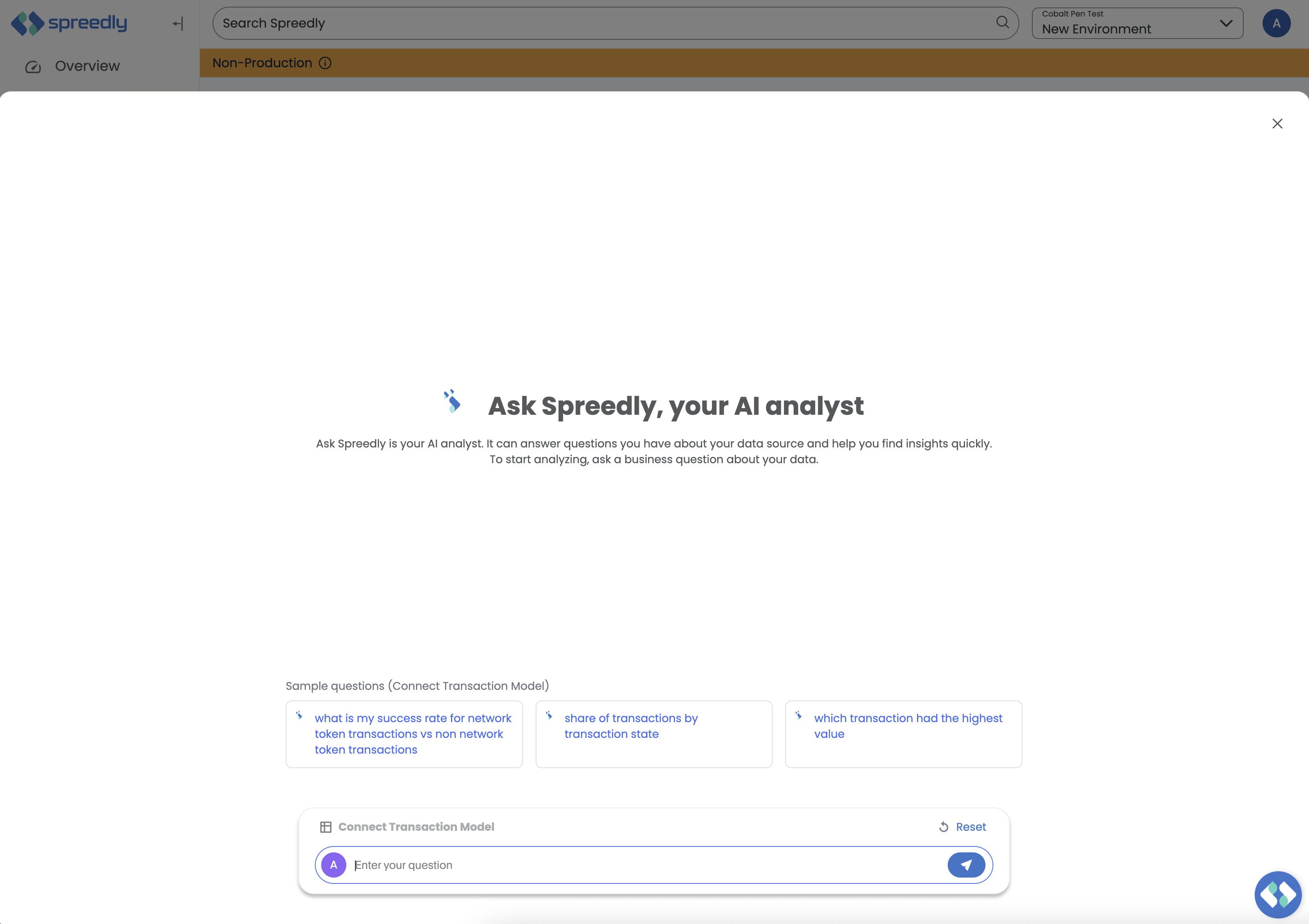
At the core of the experience is Ask Spreedly, an AI-powered chat agent trained on Spreedly's comprehensive payment transaction and vault models. This interface allows you to ask direct questions in plain language without needing specific payments/fraud awareness, technical expertise or SQL knowledge. The agent scans your recent transaction data running through Spreedly, computing formulas and generating visualizations in near real-time.
Capabilities include:
- Natural language questions: You can ask, "What was my success rate for network token transactions vs non-network token transactions last week?" or "Show me the average transaction value by gateway." The model will explain what it's doing and answer your question to the best of its ability.
- Dynamic visualizations: The AI agent generates charts and summaries within the chat session based on your questions, allowing you to visualize and understand complex data instantly.
- Operational support: Assist payments and data teams by retrieving payment details, error code breakdowns, and performance metrics across your organization's transaction history.
- Dual analysis modes: Choose between a quick visualization mode for rapid KPI queries and interactive dashboards, or a deeper research mode that generates a comprehensive analysis plan before proceeding with detailed investigation, root cause analysis of anomalies, optimization recommendations, and detailed summaries.
Payment Analytics
AI Analytics also includes an embedded visualization experience where users can explore their payments data. Unlike static reports, every chart and table is interactive, enabling you to drill down into specific dimensions such as Gateway Type, Card Brand, Currency, or Region.
Key features:
- Drill-Down & Explore: Right-click into any data point or visualization to view the underlying transaction data. You can filter by environment or view data organization-wide to isolate specific payment flows.
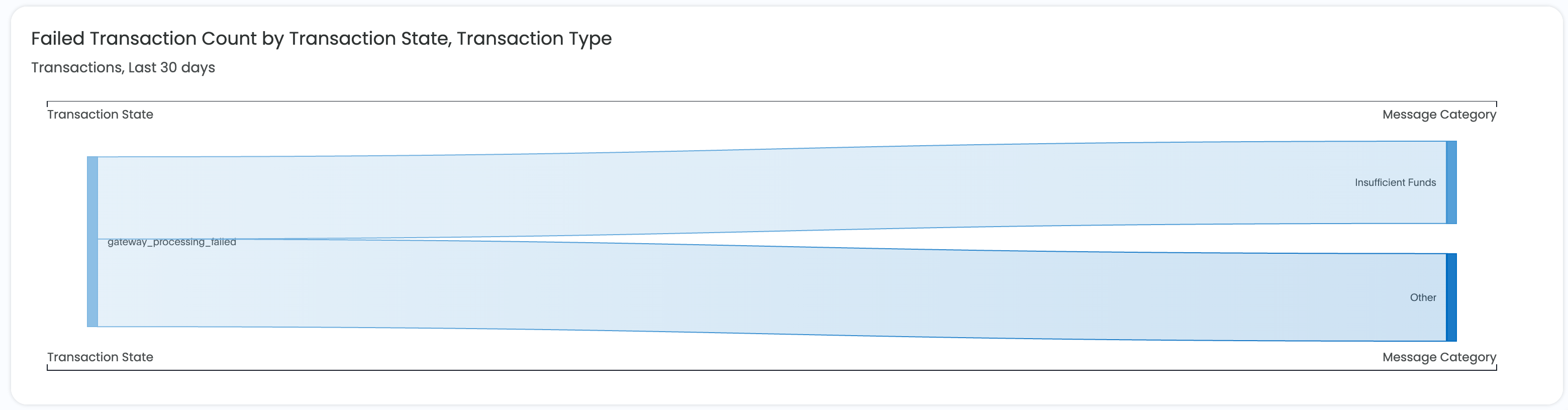
- Root Cause Analysis: deeply analyze transaction failures. Visually explore the path of failed transactions to understand error distributions across gateways and pinpoint the root cause of declines.
- Trend & Anomaly Detection: The platform automatically detects significant changes and outliers in your data. Features like AI Highlights generate summaries of KPIs, calling out unexpected trends in payment metrics like success rates so you can react faster.
Visualizations
The Payment Analytics visualizations include multiple KPIs and charts to serve as starting points for your team's analysis. These KPIs and visualizations are updated hourly to daily depending on the time series for each underlying query. For every environment, the board displays:
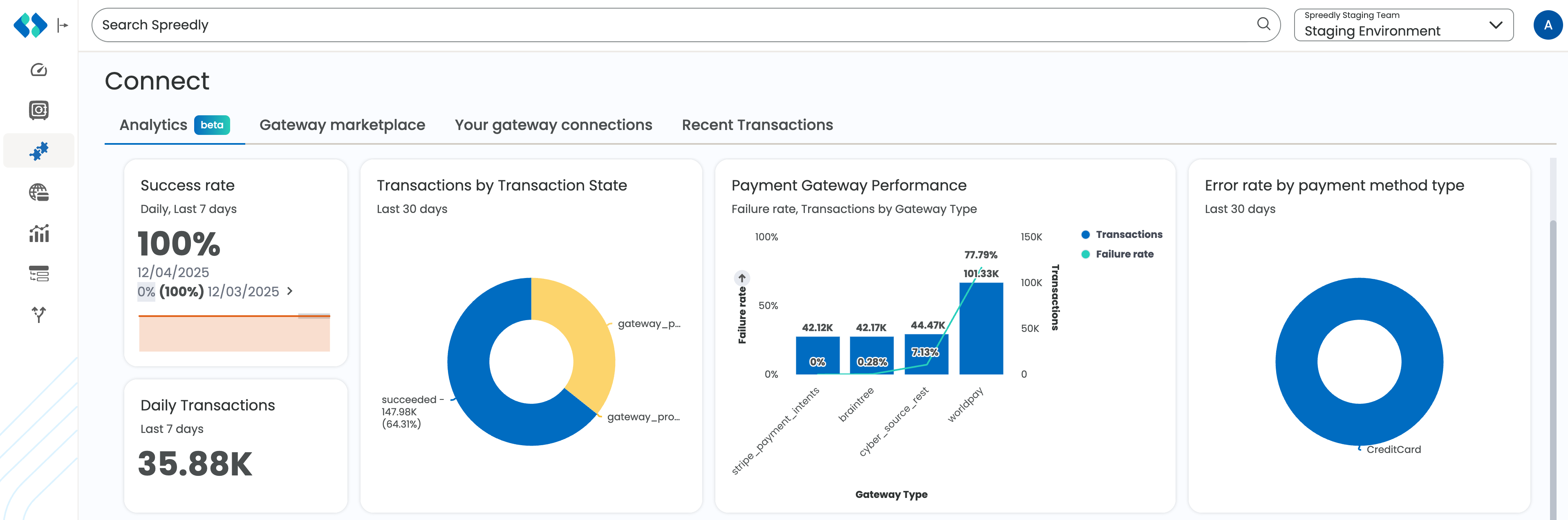
- Payment success rates, computed daily, over the previous 7 days.
- Total count of payment transactions over the previous 7 days.
- A breakdown of payment transaction status by end state according to Spreedly's data models over the previous 30 days.
- A breakdown of payment transaction performance across gateways to compare error rates and transaction counts using different PSPs over the last 30 days.
- A breakdown of error rate by payment method type included in each transaction over the last 30 days.
- A multi-dimensional Sankey diagram detailing the transaction path of all failed transactions over the last 30 days.
Payments data model
With these metrics and visualizations providing a holistic summary of key success levers and variables within your payments stack, your team can drill down and explore the underlying data model to support different operational goals. Spreedly's payments AI model includes data for the following authorization and purchase transaction types:
PurchasePurchaseViaPreuthorizationAuthorizationAuthorizationViaReferencePurchaseViaReferenceOffsitePurchaseOffsiteAuthorizationOffsiteSynchronousAuthorizationOffsiteSynchronousPurchase
All success and failure rates, transaction counts, and other formulas built into or derived while using the model will be based on definitions that include only these transaction types.
Vault Analytics
Spreedly's Vault AI model is trained on payment methods and payment method event history, providing direct guided analysis and insights surrounding the health and performance of your Vault. This specialized model enables you to understand payment method utilization, lifecycle trends, and operational metrics across your stored payment instruments. The AI chat automatically selects the proper model between transactions or vault, so you do not need to know which model has the data you are looking for—simply ask your question in natural language and the system will route your query to the appropriate AI model.
Example Queries
Here are 10 example queries that merchants can use to analyze and gather insights across payment transactions and vault models:
- "What is the success rate for transactions using stored payment methods versus new payment methods?"
- "Show me the distribution of payment method types in my vault and rank the ones with the highest decline rates."
- "How many payment methods in my vault have not been used in the last 90 days?"
- "What is the average transaction value for purchases made with network tokens compared to standard cards?"
- "Can you identify payment methods that are expiring soon and their transaction history?"
- "Show me the correlation between payment method updates and transaction success rates."
- "What percentage of my transactions are using payment methods stored in the vault versus one-time payments?"
- "Break down my failed transactions by payment method type and show me which categories need immediate attention."
- "How has my vault utilization changed over the last quarter, and which gateways seem to benefit most from stored payment methods?"
- "Identify any anomalies in payment method usage patterns that could indicate fraud or operational issues."
Payment intelligence
The AI model powering this solution is specifically coached on payment context and nearly 15 years of Spreedly's transaction history, ensuring accurate interpretation of business queries related to success rates, declines, and payment health across gateways. This allows Spreedly AI to act as a trusted partner for payment operations, helping you optimize strategies and reduce costs through data-driven decisions.
For each query entered in the chat and each visualization rendered, the payment AI agent only reviews data for your selected organization across environments. Simply specify your desired environment(s) in the query to review different data accordingly. Usage for these AI analytics models is currently unlimited for all users in organizations with access to Spreedly Connect and Vault products.
Like any LLM-based application, Spreedly's AI agent powering the AI Analytics experiences can make mistakes. We recommend double checking any outputs used for decision-making against Spreedly's API and other transaction data sources. The underlying payments and vault models are continuously trained. Additional specialized models on post-settlement data are in development, with fine-tuning and model training ongoing. Spreedly does not train AI on users' chat queries in the web application.
Updated 3 months ago